New annual URCNA statistics report

We’ve added a new Annual URCNA statistics report to Church Social, built specifically for our URCNA customers, to make annual federation reporting easier and more consistent.
Each year, URCNA church administrators have the challenging task of gathering and reviewing membership statistics for reporting to the federation. This new report helps simplify that work by automatically preparing the annual statistics commonly needed, including church officers, covenant families and singles, baptized and professing members, baptisms, professions of faith, deaths, membership transfers, releases, and removals.
The report always reflects the previous calendar year, using membership data as of December 31 of that year. For example, throughout 2026 the report shows 2025 statistics.
Each row in this report can be clicked to review the underlying people, families, memberships, or office-bearer terms that make up the statistic. Where helpful, the report also shows related details such as baptism dates, profession dates, ministers, transfer churches, membership end dates, and warnings for records that may need review.
Our hope is that this report will not only save time for local administrators, but also help participating URCNA churches generate these statistics in a more consistent way across the federation.
We’re grateful to Jody Luth, the URCNA Statistics and Directory Editor, for her help and guidance as we worked to prepare this report.
The report is available to URCNA churches in the People section on the Reports page.
New federation church directory

We’ve added a new federation and congregation directory to make church selection more consistent across Church Social.
When editing a person’s membership, baptism, or profession information, churches that participate in the directory can now select a congregation from a standardized list instead of typing the church name manually. This helps avoid duplicate variations of the same church name and makes reporting more reliable.
We’re also gradually reviewing more than 15 years of historical text-based church names in Church Social and linking them to these new church records where we can confidently determine which congregation was intended.
To start, we’ve mostly focused on NAPARC and adjacent churches, but we plan to add additional federations in the future. As of today, the following federations are included:
- Associate Reformed Presbyterian Church (ARPC)
- Associate Reformed Presbyterian Church in Canada (ARPCC)
- Canadian & American Reformed Churches (CanRC)
- Free Reformed Churches of Australia (FRCA)
- Free Reformed Churches of North America (FRCNA)
- Heritage Reformed Congregations (HRC)
- Orthodox Presbyterian Church (OPC)
- Presbyterian Church in America (PCA)
- Presbyterian Reformed Church (PresRC)
- Reformed Churches in New Zealand (RCNZ)
- Reformed Church in the United States (RCUS)
- Reformed Church of Quebec (ERQ)
- Reformed Presbyterian Church in North America (RPCNA)
- Reformed Presbyterian Church of Canada (RPCC)
- United Reformed Churches in North America (URCNA)
If a church from one of these federations is missing, or if its information is incorrect, please feel free to email us with corrections.
Manual church name entry is still available for churches that are not in the directory, or for situations where a congregation cannot be found.
Reverted automatic changes to message email notifications
We recently introduced push notifications for the Church Social iOS and Android apps. As part of that change, we added some automation to help members avoid being notified twice about new messages: once by email, and once by push notification. Once a member was consistently receiving push notifications for new messages on their phone or tablet, we automatically disabled their matching email notifications.
While this change was meant to reduce duplicate notifications, we heard from some churches that automatically changing members’ notification settings caused confusion for people who wondered why they were no longer receiving email notifications for new Church Social messages.
Based on that feedback, we’ve adjusted our approach. Going forward, Church Social will no longer automatically disable new message email notifications for members who are receiving push notifications.
Instead, we now include the following short note at the bottom of new message emails, explaining how members can turn off email notifications themselves if they’d prefer to avoid duplicate notifications:
Hey there! It looks like you're using the Church Social iOS/Android app and are already receiving push notifications for new messages. If you don't want to be notified twice, you can disable these email notifications in your account notification settings.
Please note that we are not automatically reverting this change for members who already had their new message email notifications disabled. Administrators can re-enable these notifications for members, or members can re-enable them themselves from their account notification settings. Once re-enabled, these email notifications will remain enabled moving forward.
Thanks for your patience as we continue to improve how notifications work in Church Social.
Fixed schedule sorting by description
We fixed an issue where schedules using the "Date / Description / Name" sort option could show entries in the wrong order when multiple participant types were scheduled on the same date. For example, an entry with a "4 pm" description could appear before an entry with a "2 pm" description.
Improvements to the "User roles" report

The "User roles" report now includes office-bearers roles (elders, deacons, and pastors) alongside administrators, statisticians, and the other application roles — these are all forms of elevated access, so it makes sense to see them in one place.
We've also added a new "Two-factor auth" column that shows whether each user has 2FA enabled, either because they've turned it on themselves or because it's required by their role.
Unread message badge counts in iOS and Android apps

Church Social now shows badge counts for unread messages in the iOS and Android apps.
When you have unread messages, you'll now see a small red badge on the Church Social app icon on your home screen, making it easier to know when there are new messages waiting for you. You'll also see the same unread count on the Messages tab inside the app.
This builds on our recent push notification update, and helps make sure important church messages are easier to notice and follow up on.
To use this feature, make sure you're using the latest version of the Church Social app for iOS or Android. You can find direct links to the app stores here: churchsocial.com/mobile-apps.
Two-factor authentication now required for office-bearers
Two-factor authentication is now enabled by default for Pastors, Elders, and Deacons, joining the roles we previously enabled it for: Administrators, Statisticians, Report Managers, and Treasurers.
Users in these roles will be asked to enter a security code sent to them by email when logging in.
Administrators can review and adjust these requirements in their church's security settings.
Redesigned calendar on iOS and Android

We've redesigned the calendar in the Church Social mobile app for iOS and Android, making it easier to see what's coming up — and what's already happened.
The calendar now shows a full month of events at a time, with support for browsing both past and future months. It starts by showing today's events, and you can scroll up to look back at previous events or scroll down to see what's ahead. This also means you can now view past events in the app, which wasn't possible before.
We've also added a dedicated Today button so you can quickly jump back to the current date, and the overall calendar experience has been redesigned to feel more familiar — closer to the native calendar apps you're already used to.
As part of this update, schedule entries and visits now have their own detail screens too, making it easier to see the additional information connected to those event types.
To get these improvements, please make sure you're using the latest version of the Church Social app for iOS or Android. You can download or update the app from the App Store or Google Play, and direct links are available here: churchsocial.com/mobile-apps
Improved "Families not receiving notifications" report

We’ve renamed the "Families who cannot be emailed" report to "Families not receiving notifications."
With the addition of push notifications in the mobile app, checking whether a family receives email notifications no longer tells the whole story. Some families may not be receiving email notifications, but can still be reached through the app — while others may receive email, but not push notifications.
This updated report now checks both email and push notifications, giving a more accurate picture of which families are not currently receiving notifications through Church Social.
Manage two-factor authentication for individual members
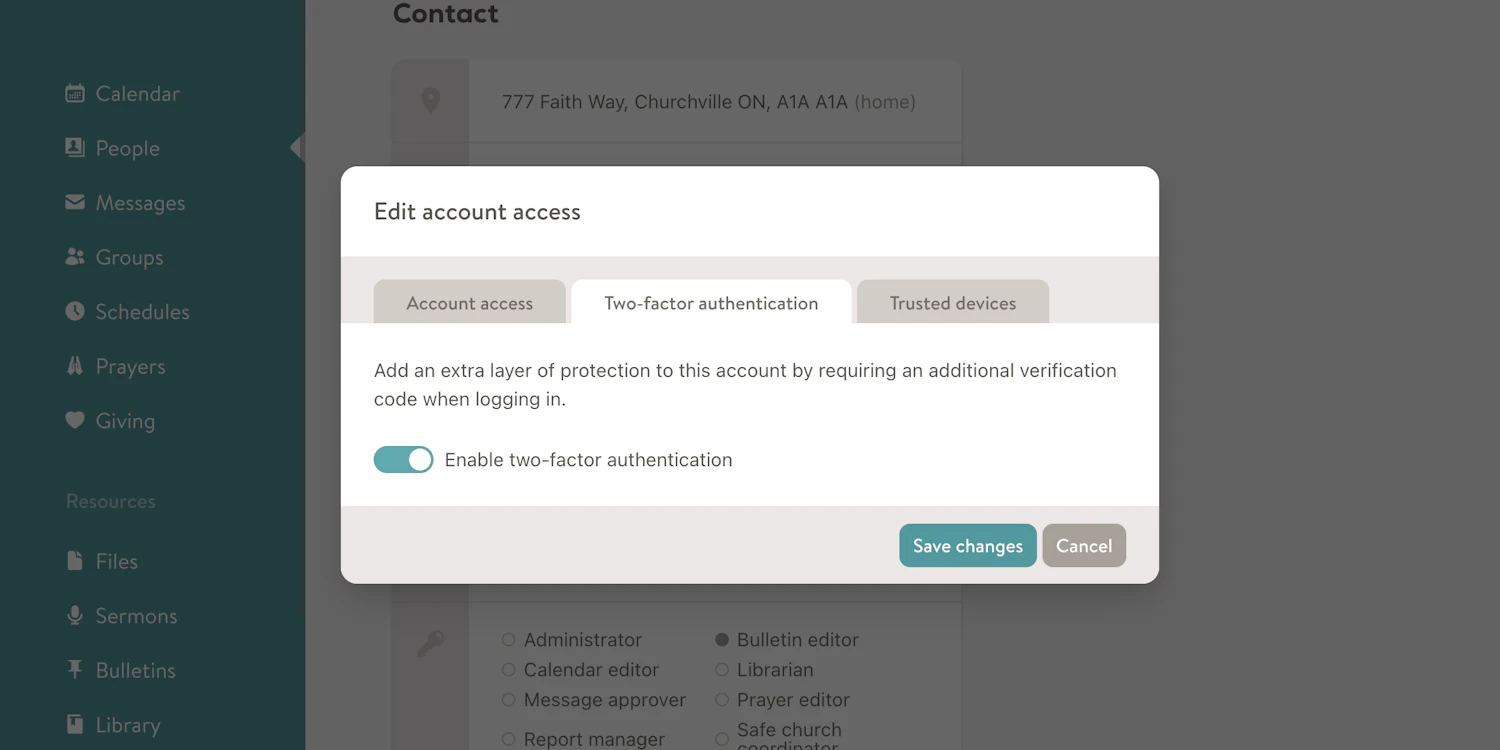
Administrators and statisticians can now turn two-factor authentication on or off for any member of their congregation. Open the Edit account access dialog from a member's profile and you'll find a new Two-factor authentication tab where you can flip the setting. If 2FA is already required for that person by your church's security settings, the toggle will be locked.
Manage trusted devices

You can now see every phone or tablet currently signed into your Church Social account through the iOS or Android app, and sign any of them out remotely.
Visit your Account → Security page and look for the new Trusted devices section. It lists each device signed into your account, along with the platform (iOS or Android), app version, and when it was last used. If you see a device you no longer use — or don't recognize — click Revoke to sign it out. That device will need to log in again the next time it's opened.
Administrators and statisticians can also manage trusted devices on behalf of other members. When you open the Edit account access dialog for a member of your congregation, you'll find a new Trusted devices tab showing the same list for that person, with the option to revoke any device on their behalf — handy for helping someone who's lost a phone or noticed an unfamiliar sign-in.
Push notifications for iOS and Android apps

Push notifications have finally arrived in the Church Social iOS and Android apps.
This has been one of our most requested improvements for a long time, and something we've wanted to add for just as long. Email notifications still work well, but push notifications feel much more natural in a mobile app. They're lighter weight, more immediate, and bring you straight into the app when you tap them. And when something isn't important, they're just as easy to swipe away and move on.
To start, we've added push notifications for the following activities:
- New messages
- Message replies
- New bulletins
Message replies
Message replies are especially exciting. Historically, replies could be easy to miss, since we only sent email notifications to the original sender in order to avoid flooding everyone's inbox. With push notifications, replies are much more visible, making it easier for conversations to actually continue instead of quietly getting lost.
We've also updated the message emails sent by Church Social to include a prominent Reply to message button. Instead of simply replying to the sender by email, members are encouraged to reply within Church Social itself. This helps foster better discussion within the congregation, while also making it easier for others to see responses as they come in—whether that's someone volunteering for a task, claiming a free concert ticket, or joining in on a conversation.
Along with these email improvements, members can now also reply to messages directly from the iOS and Android apps. Combined with push notifications for replies, this makes discussions in Church Social feel much more natural and much easier to follow.
How to receive push notifications
To receive push notifications, members will need to update to version 2.0.0 or newer of the Church Social iOS or Android app. They'll also need to allow notifications on their device. In the app, this can be checked under More → My Account → Notifications. On that screen, there is a Push notifications section that shows whether push notifications are enabled, along with a button that takes members directly to their device settings if needed.
Avoiding duplicate notifications
We've also added a bit of automation to prevent members from being notified about new messages twice — once via email and once via a push notification. Once a member is consistently receiving push notifications for new messages on their phone, we'll automatically turn off the matching email notifications for messages and replies. We send a friendly email letting them know about the change, along with simple instructions for turning email notifications back on if they'd still like to receive both.
Other mobile app improvements
This update also includes a number of other improvements to the iOS and Android apps, including:
- Refreshed and modernized app design
- Improved the login flow
- Added the ability to search past messages
- Added support for new/unread message indicators
- Added the option to mute messages
- Simplified account settings
- Added new notification settings
- Added two-factor authentication settings
- Fixed numerous bugs and performance issues
We're really excited about this release and believe it will have a positive impact on how churches use Church Social day to day.
Notifications for email address changes
When the email address on a Church Social account is changed, we now send a notification to the previous email address letting that person know. If an administrator or statistician made the change, the notification will also show who made it.
This makes it easier to spot an unexpected change — for example, one made through a phishing attempt — so the person can contact their administrator right away.
New security log
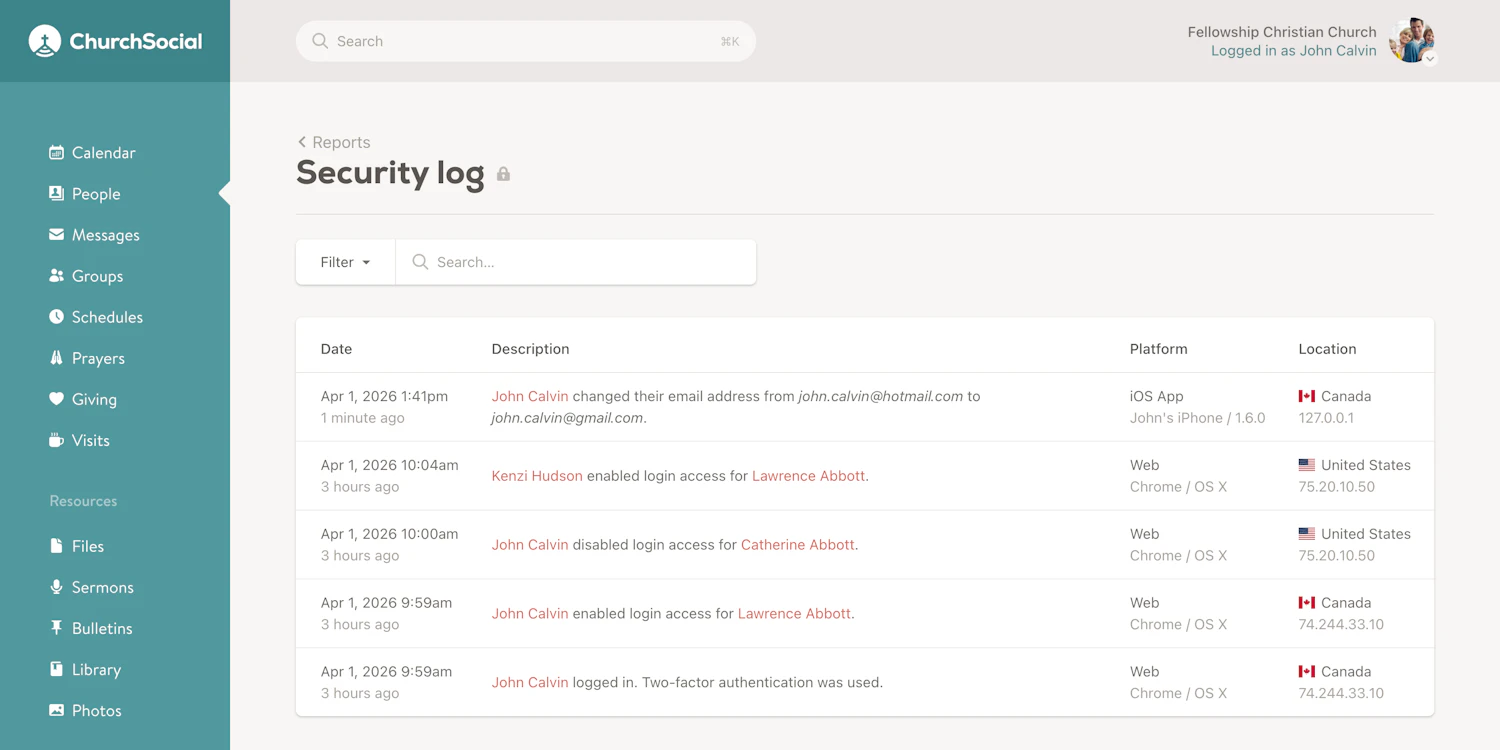
We've added a new Security log to help you keep track of important account activity within your church.
Available on the Reports page, this log includes key security-related events such as logins, password changes, email updates, two-factor authentication changes, and when important roles (like administrators and statisticians) change.
It's a simple way to gain better visibility into account activity and strengthen your church's overall security.
Create events that repeat yearly
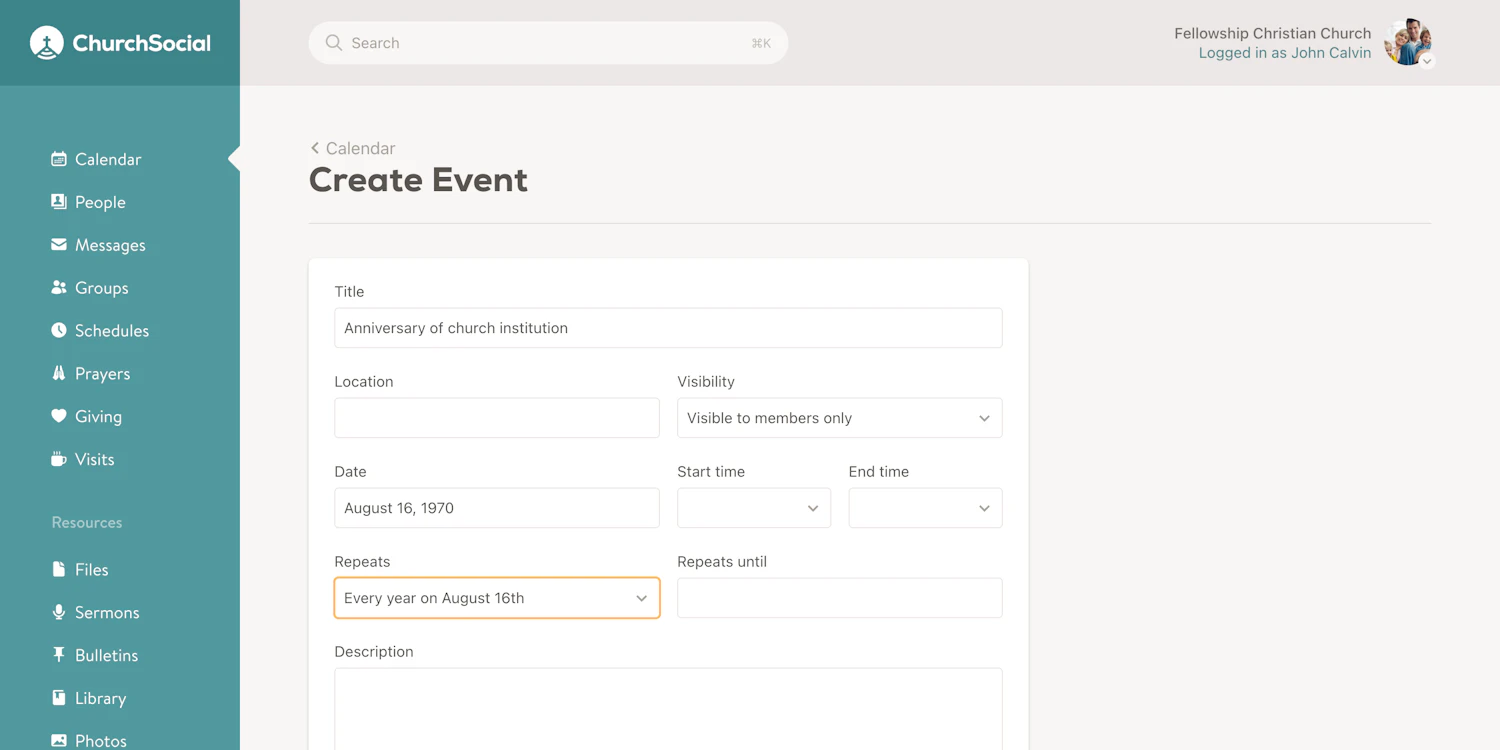
You can now create calendar events that repeat each year on the same date.
This is especially helpful for things like church institution dates, anniversaries, or other important yearly milestones that you don’t want to recreate manually each year.
When creating or editing an event, simply choose the "Every year" repeat option to have it automatically appear on your calendar each year going forward.